Southern Mongolia
With its ancient sea bottom “Flaming Cliffs” where discovered the site of
Mongolian most important paleontological findings of last century. It was here,
in 1923, that Roy Chapman Andrews and his expedition team from the American
Museum of Natural History discovered the first nest of dinosaur eggs the world
had ever seen.
Paleontologists from the world over continue to uncover fossils at this rich
site and valleys; towering singing sand dunes of Khongor, where travelers can
enjoy and explore by Mongolian Two-humped Bactrian Camels. Hike around Vulture
Valley, mountain streams create ice formations that sometimes persist till the
July.
Here in the foothills of the Gobi Altai Mountains, travelers will discover
habitat for vulture-like Lammergeiers, Argali-mountain sheep, Ibex, Eagle and
wild ass. In Mongolian south part travelers take a star watching tour falling
stars in the Desert and early in the morning can be watch how rises the sun in
Gobi. It is great experience and dream to discover under the clear sky - wide
steppe.
Baga Gazrin Chuluu
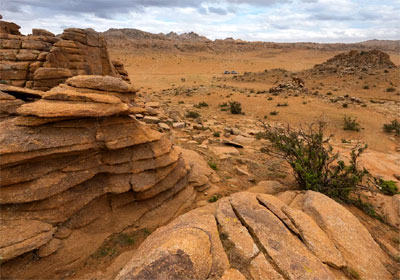 This is another granite rock formation in the middle of the dusty plains. In the
19th century, two revered monks lived here in gers - remnants of their rock
drawings can be found in the area. The rocks are worshipped by locals who
sometimes make pilgrimages here.
This is another granite rock formation in the middle of the dusty plains. In the
19th century, two revered monks lived here in gers - remnants of their rock
drawings can be found in the area. The rocks are worshipped by locals who
sometimes make pilgrimages here.
Naturally, there is a legend that Chinggis Khaan stayed at the rocks.
Five kilometers away, the highest peak in the area, Baga Gazrin Uui (1768m),
will take about five hours to climb.
The mountain also contains a cave with an underground lake. The mineral water
springs and trees in the region make it a great spot to camp, and there are
plenty of rocky hills, topped by ovoo (sacred pyramid-shaped collections of
stone and wood), to explore.
Singing Dune Khongor
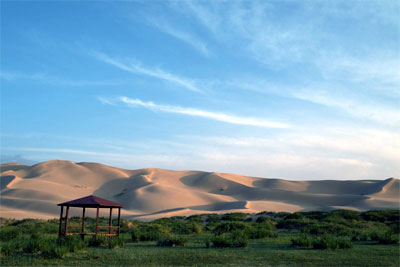 This is Mongolian largest sand dune reaching a height of 800-meter in some
highest areas. The sand dunes in Sevrei sum, South Gobi aimag, are called
Khongoryn Els. These dunes are 20 km wide and 100 km long. The Khongoryn River
flows along the sand dunes and gives birth to oases.
This is Mongolian largest sand dune reaching a height of 800-meter in some
highest areas. The sand dunes in Sevrei sum, South Gobi aimag, are called
Khongoryn Els. These dunes are 20 km wide and 100 km long. The Khongoryn River
flows along the sand dunes and gives birth to oases.
The sand dune change the color with each hour of one day, from yellow to silver
to rise colored at dawn / sundown. This dune is considered one of the biggest
dunes with it is length of 180 km and width of 3-5 km.
The dunes make sound like plane engine in a windy day so it has been named as
“Sound Dunes”.
Three Beauty Mountain National Park and Vulture valley
With a surface area of 4100 square kilometers, stretches over 100 kilometers and
includes the strictly protected zone and it is a end of Altai mountain range
Three Beauty Mountains are three rocky hills, the highest of which is 2815meter
above the sea level. The vulture valley a protected site in 1965, is 62
kilometers north-west of Dalanzadgad, in the centre of South Gobi aimag very
wide entrance, it narrows gradually into a remarkable gorge. A spring two or
three kilometers long winds its way through the defile and in July, freezing
into a thick corridor of ice that stretches along a considerable distance.
Following the canyon to the high rock walls has breathtaking dramatic scenery,
and no doubt is one of the most beautiful places in the country.
Bayanzag and Flaming Cliffs
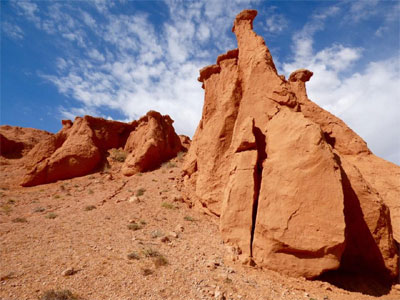 One of the famous places is Bayanzag, bottom of Ancient Sea which excited 60-70
million years ago where a lot of Palentological findings have been discovered.
This is world known as “Flaming Cliffs” so named by Roy Andrew Chapman American
explorer, who had visited Mongolia in 1920.
One of the famous places is Bayanzag, bottom of Ancient Sea which excited 60-70
million years ago where a lot of Palentological findings have been discovered.
This is world known as “Flaming Cliffs” so named by Roy Andrew Chapman American
explorer, who had visited Mongolia in 1920.
During the 2 years he searched through the Mongolian Gobi Desert & he found
dinosaur fossils from Bayanzag, Nemekht. His group brought palentological
findings on 70 camels it was like long caravan. Chapman presented Mongolia one
large skeleton on show in the Ulaanbaatar Natural History Museum. He found 10
kinds of dinosaurs 8 were found from Mongolia. But also South Gobi has an oasis
and most beautiful mountains Nemegt, Altan mountains and wide steppes and
valleys with exotic wild animals like Asian wild ass, black tailed gazelle, and
steppe wolf.
The Gobi bears which very rare animal can be seen in this area. This is one most
beautiful place among the 33 Gobies of Mongolia where travelers can see
pre-historical rock paintings, caves where monks have made meditations and ruins
of ancient temples and villages.
SOME OF OUR Partners